Technical Requirements for Turning Frequency and Methods During Fermentation and Their Role in Uniform Fermentation
In the long years of organic waste composting, I have countless times in the depths of night at the composting yard, feeling the primitive and intense rhythm of life by touching the temperature rise at the core of the pile. For practitioners, a compost pile is far more than just a heap of organic matter — it is an extremely complex, dynamically balanced bioreactor. Within this reactor, microbial respiration, heat accumulation, oxygen consumption, and moisture migration constitute a precisely orchestrated energy conversion game. In this game, "turning" — this seemingly mechanical operation — is in fact the most critical means of regulating the rhythm of microbial metabolism and maintaining the steady state of the reactor.
Many people simply understand turning as "stirring" or "ventilation," and this understanding is extremely dangerous. The essence of turning is the redistribution of physical environmental factors within the pile. Through the intervention of mechanical energy, it breaks the microenvironmental gradients formed by heat accumulation, moisture migration, and organic matter degradation, thereby achieving precise control over the fermentation process. If the turning frequency is inappropriate or the method is crude, the pile can easily fall into the quagmire of "local anaerobic conditions" or "thermal runaway," ultimately resulting in incomplete fermentation or degraded quality.
I. Parametric Logic of Turning Timing: From Biological Needs to Engineering Decisions
In practical operation, I always insist that turning must never rely solely on empirical "feeling" but must be based on real-time monitoring of the physical and chemical parameters of the pile. The "timing" of turning is essentially the critical point where the contradiction between microbial metabolic rate and environmental carrying capacity erupts.
1. The Warning Role of Temperature Gradients
Temperature is the most intuitive and core signal in composting fermentation. During the heating phase of aerobic fermentation, the rising temperature curve reflects the succession speed of microbial communities.
When the pile enters the thermophilic phase, temperatures typically fluctuate between 55°C and 65°C. This is the critical range for inactivating pathogens and weed seeds. However, if the temperature is detected to spike abnormally, exceeding 70°C or even reaching above 80°C, this is often not a good sign but rather a precursor to "thermal runaway." This means that the oxygen supply within the pile can no longer meet the high metabolic demands of microorganisms, and the rate of heat accumulation far exceeds the rate of conduction. At this point, an immediate and thorough turning is necessary — not only to cool down but also to physically displace the high-temperature material from the core to the edges, using air convection for heat dissipation and introducing fresh oxygen, preventing microbial species simplification or even death due to high temperatures.
Conversely, if the temperature experiences a cliff-like drop during the thermophilic phase with an abnormally fast cooling rate, this usually indicates two possibilities: first, excessively high moisture leading to rapid heat conduction or anaerobic conditions due to oxygen deficiency; second, an imbalance in the substrate carbon-to-nitrogen ratio (C/N), where microbial "fuel" is insufficient. In such cases, the purpose of turning is to break the physical barriers formed by moisture clumping or material settlement, thereby reconstructing ventilation channels.
2. Balance Between Oxygen Partial Pressure and Respiration Rate
Oxygen is the lifeline for maintaining an aerobic environment. Within the pile, oxygen diffusion is a restricted process. As microbial activity intensifies, the rate of oxygen consumption inside the pile rapidly exceeds the rate of diffusion through pore spaces, causing the local oxygen partial pressure (pO2) to drop below 5%.
Once hypoxia occurs, fermentation shifts from aerobic to anaerobic metabolism. Anaerobic processes not only have low heat production efficiency but, more critically, produce metabolites such as organic acids and hydrogen sulfide. These substances significantly lower the pH of the pile, inhibit the activity of aerobic microorganisms, and generate unbearable odors. Therefore, the turning frequency must match the "respiratory intensity" of the pile. During the early fermentation stage and the high-temperature peak, when metabolism is extremely vigorous, the turning frequency should be significantly increased. In the middle and later stages of fermentation, as organic matter degradation levels off, the turning frequency can be reduced accordingly.
3. Dynamic Regulation of Moisture Content
Moisture is both the medium for microbial activity and the carrier of heat transfer. The ideal moisture content for composting should be maintained between 50% and 60%.
The timing of turning must account for the effect of moisture on porosity. If the moisture content is too high (>65%), the pile exhibits a "sticky" characteristic, with pores filled by water films, causing oxygen diffusion to nearly stagnate. Turning at this point is not just ventilation but also a physical "dewatering" process, increasing the surface area of the pile to promote moisture evaporation. Conversely, if the moisture content is too low (<40%), microbial metabolic activity slows due to dehydration, and the pile appears in a "drought" state. In this case, the main purpose of turning is to redistribute moisture through mechanical agitation, avoiding the phenomenon of a "dry core."
II. Technical Requirements for Turning Methods: From Mechanical Force to Microenvironment Reconstruction
Key Technical Parameters
If "when to turn" is a strategic question, then "how to turn" is the technical core. The turning method directly determines the quality of physical structural reorganization within the pile. In practical engineering, I have summarized three core principles: the core outward transfer principle, the deep penetration principle, and the layer restructuring principle.
1. Core Outward Transfer Principle: Physical Displacement to Address Heat Accumulation
During the high-temperature phase of aerobic fermentation, the central area of the pile is where microbial metabolism is most active and heat production is most concentrated. Without intervention, the core forms a massive heat source, not only causing local microbial death due to high temperatures but also creating significant temperature gradients.
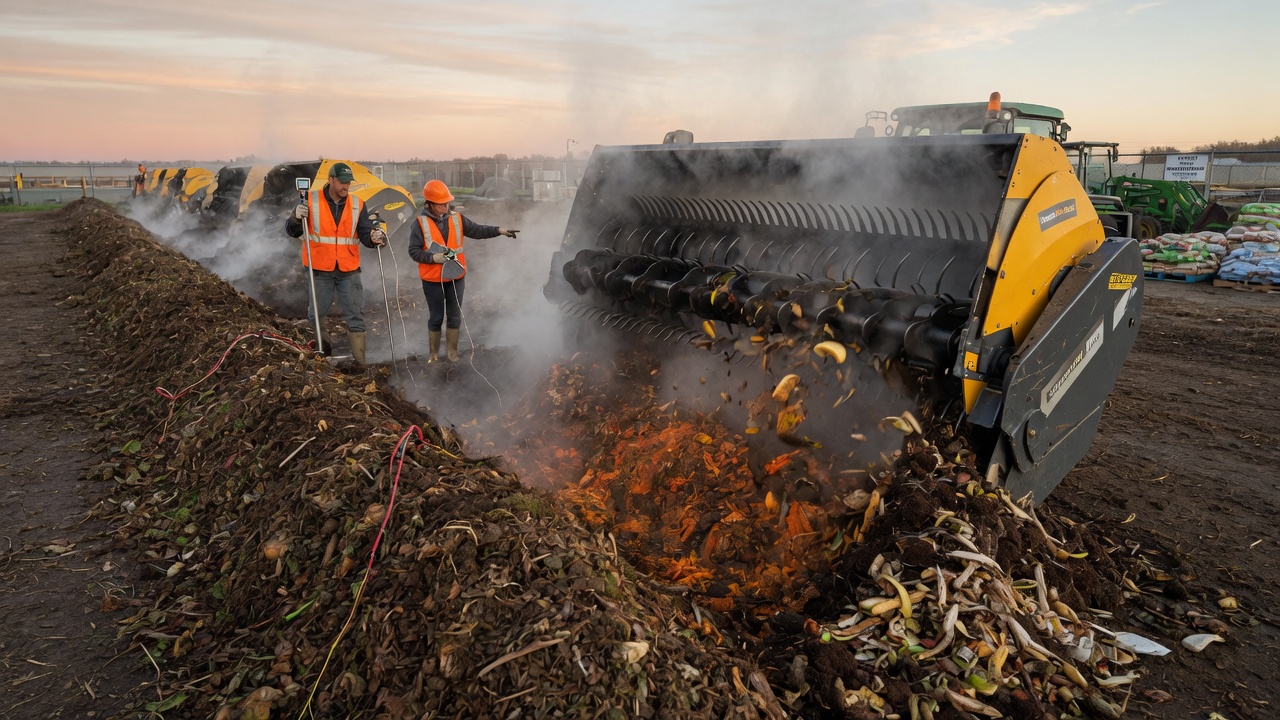
Effective turning methods must emphasize "core outward transfer." This means that the turning equipment — whether large-scale turning machines or small manual tools — must not merely perform superficial "scratching" on the pile surface but must penetrate deep into the pile, mechanically transporting the high-temperature material from the central area to the edges. Through this displacement, the cooler material at the edges acts as a buffer, while air convection at the edges rapidly carries away the heat from the core. I once observed during a high-temperature summer operation that when turning was limited to the surface, the core temperature could soar from 55°C to 75°C in just 4 hours, causing the entire pile to develop obvious anaerobic odors. After adopting a deep core outward transfer strategy, the temperature curve became very smooth, consistently maintained within a healthy metabolic range.
2. Deep Penetration Principle: The Key to Breaking Anaerobic Dead Zones
A compost pile is not a uniform medium. Due to variations in particle size and uneven moisture distribution, physical "dead zones" are easily formed inside. These dead zones typically manifest as dense clumps or muddy areas formed by moisture accumulation.
The technical difficulty of turning lies in achieving "deep penetration." Shallow turning, while introducing some oxygen, is almost ineffective for addressing oxygen deficiency in the deep, core layers of the pile. High-quality turning requires that the mechanical blades or turning shovels completely penetrate the pile, breaking apart the originally dense clumps and redistributing the material into granular form. This process of "breaking and restructuring" essentially re-establishes porosity between materials, ensuring that oxygen can permeate into every tiny pore through capillary action and convection.
3. Layer Restructuring Principle: Establishing Ordered Physicochemical Gradients
Turning is not merely about destroying the existing structure but also about rebuilding an ordered structure. During the turning process, we are essentially performing a "reshuffling" of the materials.
Excellent turning methods achieve material homogenization. Through mechanical agitation, materials that may have been clustered together — such as high-nitrogen materials, high-carbon materials, and additives of different particle sizes — can be remixed. This restructuring is crucial for maintaining the stability of the C/N ratio throughout the pile. Additionally, turning should be coordinated with moisture spraying, completing the "wetting and mixing" operation simultaneously to avoid the awkward situation of coexisting "dry cores" and "wet edges."
III. The Decisive Role of Turning in Uniform Fermentation: Breaking Spatial and Temporal Inequalities
"Uniformity" during fermentation is a core indicator of compost quality. An excellent composting process should feature spatially uniform temperature and oxygen distribution and temporally stable metabolic rates. Turning, by intervening in physical space, ensures stability in the time dimension.
1. Eliminating Spatial "Hot Spots" and "Cold Spots"
Without regular turning, the pile exhibits significant unevenness. The core becomes a "hot spot" due to intense heat production, while the edges become "cold spots" due to rapid heat dissipation or sparse material. This temperature difference not only causes severe imbalance in microbial communities but also leads to inconsistent fermentation progress — hot spots may enter the maturation phase or even carbonize prematurely, while cold spots may fail to thoroughly inactivate pathogens due to slow metabolism.
Through scientific turning frequency and methods, we can forcibly transfer heat from hot spots to cold spots and introduce oxygen from the surface into deep layers. This "redistribution of heat and oxygen" enables the entire pile to form a relatively uniform, controlled bioreaction environment, thereby achieving spatial uniform fermentation.
2. Maintaining Temporal Metabolic Stability
Fermentation is a continuous biochemical reaction. If the turning frequency is too low, the pile experiences intense fluctuations of "aerobic — anaerobic — aerobic." The consequences of such fluctuations are fatal: the outbreak of anaerobic periods leads to organic acid accumulation, altering pH and creating a "fault" in the metabolic pathway.
Regular turning essentially provides a "continuous oxygen supply guarantee" for microorganisms. It transforms what could be intense metabolic fluctuations into a smooth, continuous energy release process. This temporal stability is the fundamental guarantee that the fermentation process can smoothly transition from the thermophilic phase to the maturation phase.
IV. Practical Case Study: Response Strategies Under Extreme Climate Conditions
To more intuitively understand the value of turning technology, I want to share an experience from a large-scale municipal organic waste composting project in a hot and humid southern region during the rainy season.
At that time, due to continuous monsoon rains, the surface moisture content of the pile rapidly climbed above 70%, and because of the extremely high ambient temperature, heat production inside the pile was abnormally intense. Initially, we followed the conventional practice of turning "once every 3 days," and problems soon emerged: although the surface of the pile appeared to be fermenting, as soon as we cut into it, we could smell strong ammonia and hydrogen sulfide odors, and the core temperature once reached 78°C.
After recognizing the problem, we immediately adjusted our strategy, implementing a combination of "high frequency, deep penetration, and moisture compensation":
- Increase frequency: The turning frequency was temporarily increased from once every 3 days to once a day to cope with extreme oxygen consumption under high temperatures.
- Deep penetration: We abandoned the original surface-type turning machine and switched to a heavy-duty turning machine with deep plow structure, ensuring the turning depth reached over 80% of the pile height, thoroughly breaking apart the sticky clumps formed by excessive moisture.
- Moisture compensation and physical dewatering: During turning, we utilized the mechanical force of the turning machine for physical "squeeze dewatering," combined with a spray system to maintain the internal moisture content of the pile at the ideal range of approximately 55%.
After a week of adjustment, the temperature curve of the pile clearly stabilized, remaining steady at around 60°C, and the odor problem disappeared. This experience profoundly reminded me that when facing extreme conditions, turning is no longer a simple maintenance task but a "game of time and space" against microbial metabolic rates.
Conclusion: Technology, Experience, and Reverence for Nature
Turning technology, seemingly a combination of mechanics and physics, is in fact an art of "balance." It requires us not only to master hard parameters such as temperature, oxygen, and moisture but also to possess keen insight to capture the subtle changes hidden within the pile.
An excellent composting technician should treat every pile like a precision instrument. We must provide microorganisms with sufficient breathing space through precise frequency control and ensure uniform distribution of heat and nutrients through professional operational methods. This rigorous pursuit of technology is essentially a respect for the laws of biological metabolism and the only way to ensure that every organic material can return to the land and nourish life through efficient fermentation.